Someone in your city just typed “best moving company near me” into ChatGPT. Three names came up. Yours wasn’t one of them.
Here’s the good news. That result isn’t random, and the best part is that it’s not even permanent. ChatGPT picked those three moving companies for specific reasons. Once you know what those reasons are, you can start showing up too and reaching your target audience.
In this guide, we’ll break down exactly what signals ChatGPT and other AI tools use to recommend moving companies. You’ll also find this guide to be an excellent blueprint for learning what you can do to build those signals yourself.
No theory. No fluff. Just what works and what to do about getting your moving company recommended by ChatGPT.
One quick definition before we start. You’ll see the term GEO a few times. It stands for Generative Engine Optimization. It’s just the work of getting your business recommended by AI tools, the same way traditional SEO gets you found on Google.
How Moving Companies Get Recommended by ChatGPT and AI Tools?
ChatGPT recommends moving companies based on the trust signals it finds across the web and not any sort of paid placement. The companies it names tend to share six traits:
- Strong, recent reviews across Google, Yelp, BBB, and Moving.com (around 4.3 stars or higher)
- Consistent business info, including matching name, address, and phone everywhere online
- Mentions in third-party content like local news, blogs, and real estate articles
- Helpful website content that answers real moving questions
- Complete, verified listings on Google Business Profile, Bing Places, and industry directories
- Appearances in “Best Movers in [City]” listicles, which ChatGPT repeats often
If you can build these signals consistently by generating content relevant content, you can expect your name to start surfacing in AI recommendations within 3 to 6 months.
AI Search Is Now a Lead Source in the Moving Industry You Can’t Ignore
A lot of your customers don’t start on Google anymore. That’s just simply becoming the new reality in this age of AI. Existing as well as potential customers now start by asking an AI.
ChatGPT, Perplexity, and Google’s AI Overviews are becoming the first stop for people planning a move. ChatGPT alone passed 1.1 billion monthly users in 2026. Roughly a third of people now begin a search with an artificial intelligence tool instead of a search engine.
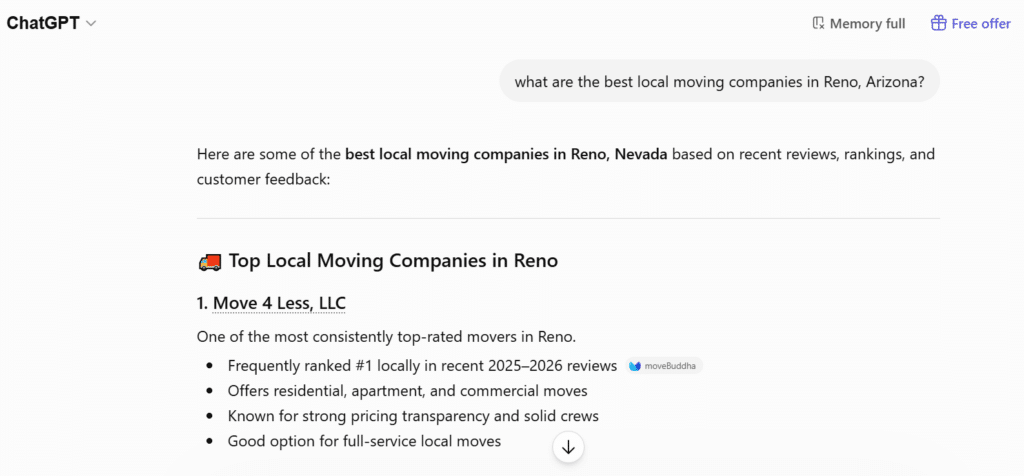
Here’s what makes this different from traditional search. These tools don’t hand you ten blue links to sort through. They give a short, named recommendation with reasons attached. Something like, “Suburban Solutions is well reviewed and has served the area for years.” To the customer, that reads like advice from a friend, not an ad. So they call the name they were given.
That’s the part that should get your attention. When AI names a competitor and not you, you don’t even know the lead existed. The phone just doesn’t ring.
The movers who understand this early have a real edge. They can win more customers while their competitors stay invisible.
Want to see where you stand right now? Open ChatGPT and type this prompt: “What are the best moving companies in [your city]?” Whatever the AI results show is a snapshot of what it currently knows about your market. Keep that answer in mind as you read on.
How Moving Companies Get Recommended by ChatGPT and AI Tools?
ChatGPT recommends moving companies based on the trust signals it finds across the web and not any sort of paid placement. The companies it names tend to share six traits:
- Strong, recent reviews across Google, Yelp, BBB, and Moving.com (around 4.3 stars or higher)
- Consistent business info, including matching name, address, and phone everywhere online
- Mentions in third-party content like local news, blogs, and real estate articles
- Helpful website content that answers real moving questions
- Complete, verified listings on Google Business Profile, Bing Places, and industry directories
- Appearances in “Best Movers in [City]” listicles, which ChatGPT repeats often
If you can build these signals consistently by generating content relevant content, you can expect your name to start surfacing in AI recommendations within 3 to 6 months.
The Signals That Make ChatGPT Trust a Moving Company
It helps to picture what this AI chatbot actually is. It is not a search engine. Think of it more like a researcher who has read thousands of reviews, articles, and business listings, and then gives you a recommendation based on everything it has seen.
So the real question is simple. What has that researcher read about your company?

Here are the six signals that matter most.
1. Reviews Across Multiple Platforms
This is the big one. AI systems look at how many reviews you have, how recent they are, and what they say. And they pull from more sources than one, including Google, Yelp, BBB, and Moving.com, not just a single site. There’s even a bar to clear.
One 2026 analysis of AI recommendations found that the companies ChatGPT names average about 4.3 stars. Drop below that, and you often get left out entirely. The lesson is plain: more positive reviews, in more places, means a stronger signal.
Aim higher than the bar, not just at it. A company sitting at 4.8 stars with fresh reviews every week is a far easier call for AI than one parked at 4.3 with nothing new in months.
2. Consistent Business Info
Marketers call this NAP, which stands for Name, Address, and Phone number. Yours needs to be identical everywhere online. Think of it like a business card. If three listings show three slightly different phone numbers or addresses, the AI can’t be sure they all point to the same company, and it loses confidence in recommending you.
Old listings are a common culprit here. An address from two offices ago, or a phone number you dropped years back, can quietly drag down your signal.
3. Mentions in Other People’s Content
Local news stories, industry articles, and blog posts that mention your company tell AI that you’re real and that people are talking about you. This matters because you’re no longer just vouching for yourself.

Outside sources are backing you up. A mention in a community newspaper, a sponsor logo on a local charity’s site, or a quote in a real estate article all count. The interesting part is that none of them has to link back to your website. The mention alone still registers.
4. Helpful Website Content
Movers with detailed, useful content on their sites get more weight. If your website actually answers common moving questions, AI sees a company that knows its trade. A thin, three-page site tells it the opposite. Pages that explain your pricing, your process, and what to expect on moving day all point to a company that knows what it’s doing.
5. Verified Business Listings
Your Google Business Profile, your Bing Places listing, and industry directories like Moving.com and HireAHelper all feed your AI footprint. Bing matters more than most movers expect, because ChatGPT leans heavily on Bing’s index to find local businesses in the first place.
6. Listicle Appearances
These are the “Best Movers in [City]” roundup articles you see on local blogs, real estate sites, and consumer guides. ChatGPT pulls from them constantly, and it often repeats the names on those lists almost word for word. Showing up on several independent lists is one of the highest-leverage moves a mover can make.

We’ll come back to this one in the next section, because it’s worth doing on purpose. For example, picture a popular local blog that lists the five best movers in your city. When someone asks ChatGPT that same question, those five names are exactly what it’s likely to repeat.
What Movers Need to Do Right Now to Get Recommended
Knowing the signals is half the battle. Here’s how to build them. Treat each of these as a task on your list, not an idea to think about later. You don’t have to do all six at once. Start at the top and work down. Each one you finish makes the next AI recommendation a little more likely to include you, and over time, more jobs.
Build Your Review Base Systematically
Set up a simple process to ask happy customers for a review after every completed job. A text message with a direct link works best while the move is still fresh in the customer’s mind. Respond to every review you get, the good ones and the bad ones. That back-and-forth shows AI an active, engaged business.

And keep them coming steadily, because both volume and recency count. A slow, steady stream beats one big burst that then goes quiet for a year. Make it as easy as possible. A QR code on the final paperwork, or a one-tap link in a follow-up text, removes every excuse not to leave one.
Audit Your Directory Listings
Pull up your moving business on Google, Yelp, BBB, Bing, and the local directories you can find. Check that your name, address, and phone number match exactly on each one. Even small differences, like “St.” on one and “Street” on another, can muddy the signal. A tool like BrightLocal can speed this up, or you can do it by hand with a spreadsheet. Then fix every inconsistency you find.
Create Content That Answers Real Questions
Write blog posts and service pages that answer questions your customers actually ask. “How much does it cost to move a two-bedroom apartment?” “Is [city] a good place to live?” are the kind of thing people type into both Google and ChatGPT. AI pulls from sites that show real expertise, so the more honest, useful answers you publish, the better.
This part takes time, and most owners don’t have much to spare. If you’d rather hand it off, some firms focus on exactly this kind of work for moving companies, like Mover Search Marketing.
Get Into Listicles
This is the high-leverage one. Reach out to local bloggers, real estate agents, neighborhood guides, and consumer resource sites in your market. Ask to be included in their “Best Movers in [City]” roundups. Offer them something useful in return, like a quick quote or a helpful stat. Every list you land on is another trust signal AI registers. The more independent lists carry your name, the more often AI will repeat it. Not sure which lists to target? Search “best movers in [your city]” yourself. Every roundup that comes up is a list worth pitching.
Claim and Complete Every Business Profile
If you haven’t claimed your Google Business Profile, Bing Places, and your industry directory listings, do it this week. Then fill them out completely. Hours, services, service areas, photos, all of it. A half-finished profile is close to invisible to AI, and an unclaimed one is worse. Complete profiles also tend to win the tie. When two companies look similar, AI leans toward the one it has more information about.
Add Local Business Schema to Your Website
Here’s a quick technical note. Schema markup is a small piece of code that spells out your business details in a format AI reads easily. It tells AI exactly what you are, where you work, and what you offer, with no guessing. You don’t need to understand the code yourself. Just flag it to your web developer and ask them to add LocalBusiness (e.g. MovingCompany) schema to your site.

How Long Does It Take to Show Up in ChatGPT?
Straight answer: it’s not instant. AI visibility builds over time as your signals add up.
Part of this is how the technology actually works. The live search side can pick up a new review or a fresh listing fairly fast, sometimes within days. But the deeper pattern, the one where AI confidently recommends you by name, takes longer. That confidence grows as reviews, mentions, and listings stack up across the web over weeks and months.
Plan on 3 to 6 months of steady effort before you see meaningful AI visibility. The first month or two is foundation work, claiming profiles and fixing your listings. By month three or four, your signals start to register. Around month five or six, your name starts surfacing in those AI recommendations.
Here’s an easy way to track it.
- Once a month, open ChatGPT and ask for the best movers in your city.
- Write down what it says. Over time, you want to watch your name move from missing, to an occasional mention, to a regular pick.
- That progression is your scoreboard.
Yes, companies that have been active for years have a head start. They already have more reviews, more mentions, and more listings out there. But that gap is closeable, and here’s why. Most of those companies aren’t actively working on AI visibility either. They’re coasting on what they happen to have. Consistent, deliberate effort can close the distance faster than you’d think.
The takeaway is simple. Start now. Every month you wait, a competitor’s signals keep growing while yours sit still.
Get Your Moving Company Listed on Moverville
Here’s one easy signal you can build today to get your moving company recommended by ChatGPPT. Get listed in Moverville’s verified directory of moving companies.
A Moverville listing is a trust signal in itself. It’s a third-party, industry-specific mention of your moving business that AI tools can find and reference. Your name, location, and services get indexed on a site built entirely around the moving industry. That’s exactly the kind of credible, on-topic mention AI looks for when it decides who to recommend.
FAQs
Do I Need a Sales Team to Get More Leads From AI Search?
No. AI visibility doesn’t depend on sales reps or a dedicated sales team. It depends on the signals your business can generate online. Reviews, accurate listings, helpful content, and third-party mentions are what earn ChatGPT recommendations, and they keep working whether or not anyone is making calls. For small moving companies without a sales department or a marketing team, that’s good news: a single owner can build these signals and still compete for more leads against larger competitors.
Does AI Visibility Help During Busy Seasons?
Yes, and it matters most then. Busy seasons, typically late spring through summer, are when the most customers are asking AI tools for moving recommendations. If your trust signals are already in place when demand peaks, you capture more of that traffic instead of watching it go to competitors. The catch is timing: AI visibility takes 3 to 6 months to build, so the work has to start well before your busy seasons, not during them.
Can a New Moving Company Compete for AI Recommendations?
Yes. Even new movers can earn ChatGPT recommendations, because AI visibility rewards consistent signals more than years in business. Established companies have a head start on reviews and mentions, but many aren’t actively working on AI visibility, they’re coasting.
What Tools or Software Do I Need for GEO?
Very little. You can manage most GEO work with free tools, including your Google Business Profile dashboard, a spreadsheet to track listings, and ChatGPT itself for monthly check-ins. Paid software like BrightLocal can speed up a directory audit, but it’s optional. A few practical tips: keep your business info identical everywhere, ask for reviews after every job, and check your ChatGPT visibility monthly. The work is more about consistency than expensive software.
What Content Helps a Moving Company Get Found by AI?
Content that answers the real questions customers ask. People search AI tools for things like the cost of a two-bedroom move, how to get an estimate, or how to plan a stress free move. When your site genuinely answers those questions, AI sees expertise and is more likely to recommend you.
Is AI Search the Future of Finding a Moving Company?
Increasingly, yes. A growing share of customers now hear about movers through AI tools rather than traditional search, and that share is rising as ChatGPT and similar assistants mature. This doesn’t mean Google disappears. The future favors companies visible in both places. Tracking your performance matters here: check your AI recommendations monthly and watch your name move from missing, to mentioned, to recommended. Movers who treat AI visibility as a long-term strategy are the ones customers will find first in the future.
The Bottom Line
Ultimately, AI visibility isn’t bought, and it isn’t gamed. It’s earned, through consistent signals across reviews, listings, content, and mentions. ChatGPT recommends the companies it has the most reason to trust.
The movers who start building that trust now will pull ahead. Every review, every listing, every mention compounds on the last. Six months from now, you can be one of the three names that come up, instead of the owner wondering why you never do.
Pick one task from this guide. Start today.
Author Bio:
As the head of AI and SEO at Mover Search Marketing, Shannon Hayner brings a wealth of insights to help moving companies navigate the ever-changing search landscape with a focus on measurable growth. In her book Surviving Creative Evolution, she tackles automation anxiety, championing human gifts like creativity and critical thinking, and she brings that same perspective to AI Overview optimization and SEO across engines like ChatGPT, Claude, Perplexity, and Google’s AI Overviews.
About Mover Search Marketing
Mover Search Marketing helps moving companies generate more leads through SEO, Google Business Profile optimization, website design, paid advertising, and AI search optimization.
Unlike general marketing agencies, we focus exclusively on the moving industry. We understand what movers need because we’ve spent years working with moving companies and helping them grow.
Our goal is simple: increase your visibility, generate more qualified leads, and help you book more moves.
Find A Moving Company Supplier
About Moversville
Moversville Marketing Services for Movers – Boost repeat business, increase referrals, and stay top-of-mind year-round—all without writing a single email. Moversville gives moving companies a fully managed email marketing system, complete with custom content, automated campaigns, and consistent monthly outreach to your past clients, referral partners, and leads. It’s hands-off, high-impact marketing built specifically for movers.