Search Google for almost any moving question and watch who shows up. It is rarely a moving company with the biggest trucks or even the biggest ad budget. It is usually a site that has answered that question, and fifty related ones, in depth.
Google has spent years tuning its systems to reward websites that demonstrate expertise across an entire topic, not just a single page that matches a single search.
That shift is good news for moving companies, and most owners have not noticed it yet. Moving is a bounded subject.
There are only so many things people ask about it, which means a local mover can realistically cover the whole territory. Do that, and you build something called topical authority for movers: a site Google treats as a trusted source on moving, and ranks accordingly.
In this guide, we’ll see what topical authority is, why it is better than publishing isolated blog posts, and how to build it piece by piece to rank higher.
What Topical Authority Means
Topical authority is the credibility your website earns by covering a subject completely and connecting that coverage together. When a site publishes deep, interlinked content across every corner of a topic, search engines learn to associate the site with the topic itself.
Three ingredients build it.
- Depth: Each page treats its question thoroughly instead of skimming it.
- Breadth: The site covers the subtopics around the main subject, not just the profitable center.
- Connection: Pages link to each other in ways that show how the ideas relate.
Here’s an example of a moving company’s website that has built many dedicated pages for each service and location to build topical authority:

Here is why the concept matters so much for smaller businesses.
Unlike domain authority, which measures overall website strength and backlink profile, topical authority in SEO is about proven expertise within a specific subject. That is why a smaller mover can still build high topical authority within moving.
Topical authority is one of the few forces in SEO that lets a focused site outrank a much larger one. A national aggregator has millions of pages about everything. A Tampa mover with sixty excellent, interconnected pages about moving can be the better source on that subject, and Google increasingly agrees.
Why Topical Authority Matters for Moving Companies
Moving companies compete against two kinds of rivals in search: national lead sellers with enormous websites, and the other local movers in town.
Topical authority is the strategy that beats both, because neither tends to pursue it.
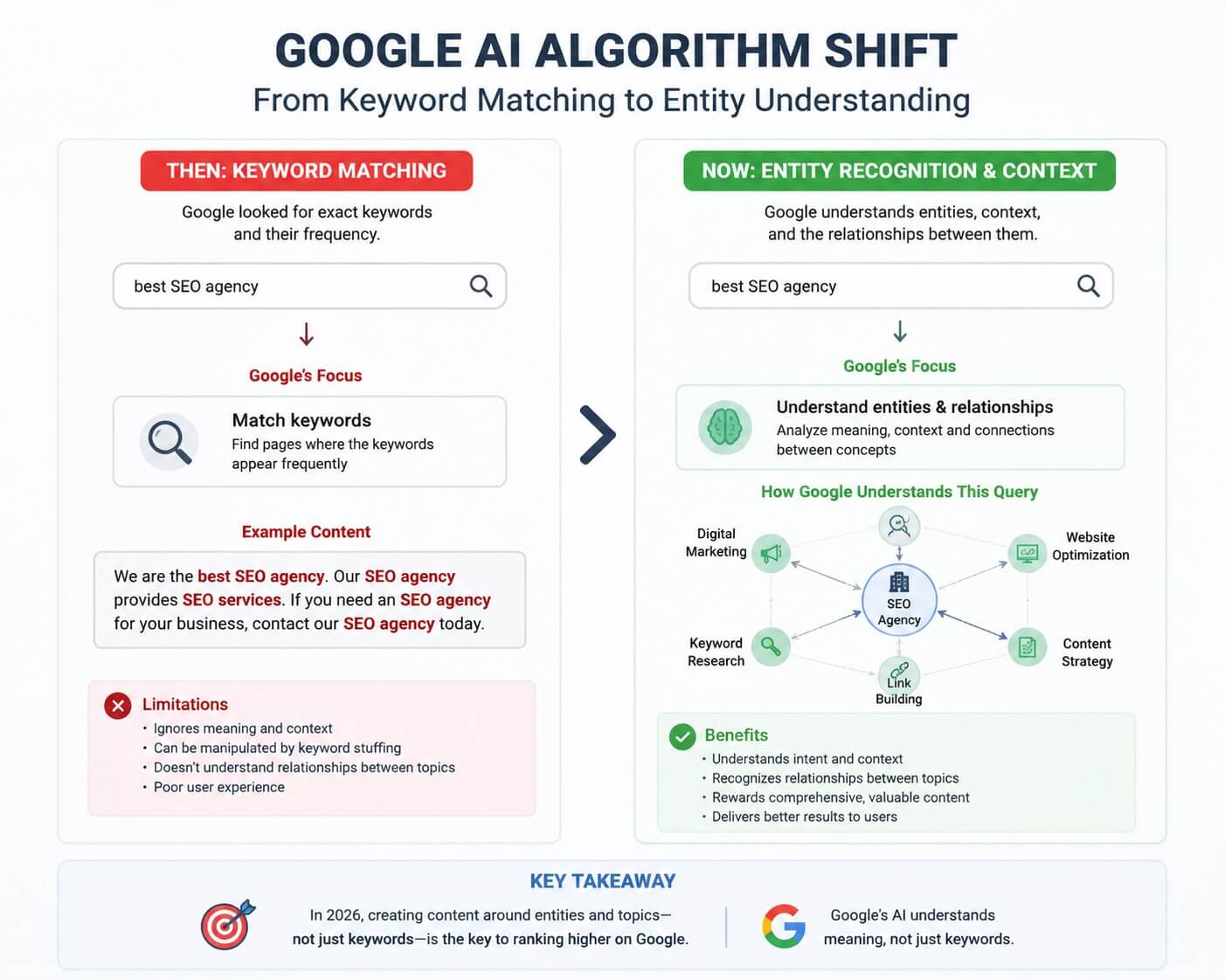
The aggregators cover moving alongside a hundred other industries, so their moving content is broad but shallow. Most local competitors publish a few service pages and a blog that went quiet in 2023.
A mover that commits to complete coverage of its own subject occupies ground nobody else is holding, which is why topical authority matters for trust, rankings, and stronger organic traffic.
There is also a compounding benefit that owners usually start to notice after 6–12 months, since topical authority is important but rarely immediate.
On a site with established authority, new content ranks faster. The fifteenth article in your moving-cost cluster does not start from zero the way your first one did. The site already carries a reputation on the subject. Each piece you publish makes the next piece cheaper to rank.
And one practical point deserves repeating: the moving topic map is finite. A finance blog can never finish covering finance. A moving company can genuinely become the most complete moving resource in its market within a year or two of steady publishing. Few industries offer that.
Topical Authority and Google’s Helpful Content Systems
Google has folded its helpful content signals into its core ranking systems, and the guidance behind them reads like a description of topical authority.
Google’s own documentation asks site owners to evaluate whether their content provides “a substantial, complete, or comprehensive description of the topic” and whether it demonstrates first-hand expertise, subject matter expertise, and content depth.

Notice what those questions assess. Not keywords. Not word counts. Completeness and expertise, judged at the level of the site as much as the page.
Real expertise is best shown through firsthand examples, operational detail, or case studies from actual moves, which also strengthens credibility. Google’s guidance also asks whether a site has a clear primary purpose or focus. A mover publishing only about moving demonstrates exactly that. A site chasing random trending topics does not.
The practical translation for an owner: every piece you publish either strengthens Google’s confidence that your site is a genuine moving resource, or dilutes it. Topical authority is how you stack that judgment in your favor, one page at a time, especially when strong content quality supports e e a t.
AI Search Engines Reward the Same Depth
The rise of AI answers has raised the value of authority instead of lowering it. When ChatGPT, Gemini, or Google’s AI features generate a response about moving, they synthesize from sources they judge reliable, and authoritative content plus a website’s topical authority increase the likelihood of appearing in ai generated answers and other AI search features.

Google’s guidance for its generative AI features points to the same fundamentals: helpful, people-first content with no special tricks required.
A site with one thin post about moving costs gives an AI system little to work with. A site with a full cost guide, a deposit explainer, a tipping article, and a piece on long-distance pricing gives it a source worth citing repeatedly. Build authority for Google, and you are building it for the answer engines at the same time.
Building Topic Clusters Around Moving Services
The working unit of topical authority is the topic cluster, and topic based keyword research helps define each pillar, each supporting page, and the keyword cluster they should target.
One comprehensive pillar page covers a broad subject, supporting articles cover its narrower questions, and links connect all of them to create a strong internal structure.
HubSpot popularized the model, and its research found that more interlinking between related pages produced better search placement. One strong cluster page lifts the others linked to the same pillar.

Here is what a cluster looks like for a mover.
- The pillar is a complete guide to long-distance moving.
- The supporting articles answer its parts: what long-distance moves cost, how to choose an interstate mover, and how delivery windows work.
- Add moving cross-country with pets and whether to ship or sell your car to cover more relevant subtopics.
- Each article links up to the pillar. The pillar links out to each article. A reader can enter anywhere and find the rest.
One cluster will not transform your rankings. Five or six clusters, built over a year, will change how Google categorizes your entire site.
The Content Categories Every Moving Company Should Cover
Think of these ten categories as the map of the moving topic, with the goal of comprehensive content across a particular topic, not just a few sales pages.

A mover with real coverage in each has few gaps left for a competitor to exploit. The first six are service categories, where your revenue lives.
- Local moving. Your bread and butter deserves more than one page: hourly pricing, crew sizes, how a move day actually runs. Hyper-specific neighborhood or suburb guides are also relevant topics that can help a local mover build authority in its service area.
- Long-distance moving. The highest-value cluster, covering interstate logistics, delivery windows, and cost drivers.
- Commercial moving. Office relocations, minimizing downtime, moving equipment and files. Business searchers ask different questions than families do.
- Residential moving. Apartments, houses, seniors downsizing, students. Each audience searches differently.
- Packing services. Full packing, partial packing, supplies, and what professional packers do that DIY misses.
- Short-term, long-term, storage-in-transit, and climate control, especially if you sell it.
The other four are informational categories. They rarely sell directly, but they pull in future customers early and prove your expertise to both readers and machines on a specific subject.
- Moving costs. The highest-traffic questions in the industry. Honest ranges and cost factors, updated yearly.
- Moving checklists. Week-by-week timelines, packing checklists, change-of-address lists. Endlessly searched, endlessly shared.
- Moving tips. The how-to layer: packing dishes, moving a piano, protecting floors, moving in the rain.
- Seasonal moving advice. Summer demand and pricing, winter weather moves, end-of-month crunches, holiday scheduling.
Service categories convert. Informational categories build the authority that helps the service pages rank. You need both, and they need to link to each other.
Creating Pillar Pages and Supporting Articles
A pillar page is the comprehensive hub for one category: the complete guide to packing services, the full breakdown of moving costs. It targets the broad, competitive search term, chosen through keyword research by weighing search volume, keyword difficulty, and the best target keywords, covers the whole subject at a useful level, and points readers deeper.
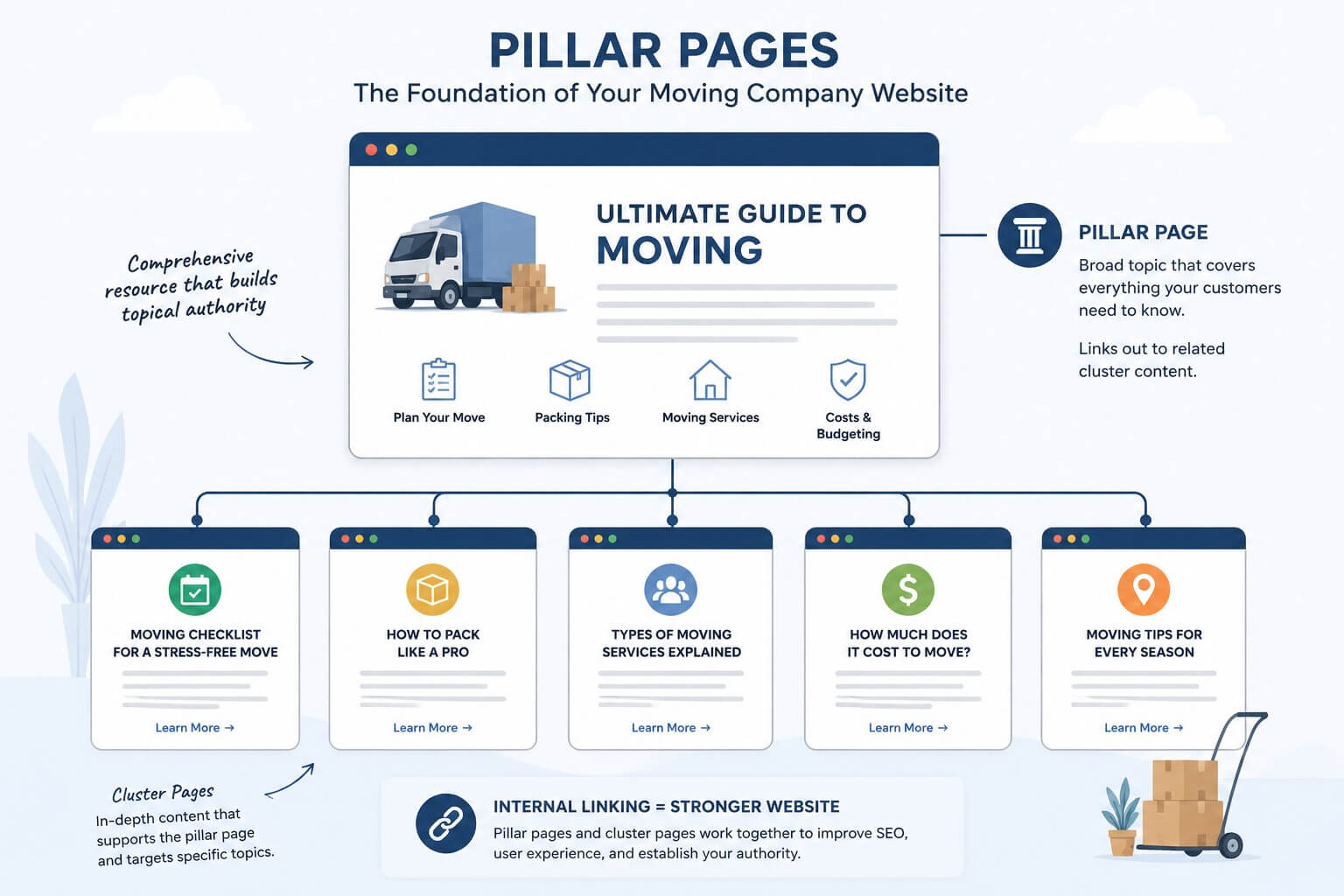
Supporting articles do the opposite job. Each one takes a single narrow question and answers it better than anyone else, matching user intent and search intent for that question, often with a short how to guide.
- How much does it cost to move a piano?
- Should you tip movers, and how much?
Those pieces target long-tail searches with less competition, and they win traffic the pillar alone never could. The two formats feed each other.
Supporting articles pass relevance and internal links up to the pillar, which helps it compete for the hard keyword. The pillar sends readers and authority down to the articles.
Write the pillar first so you can group all the keywords and specific topics by intent before building out the supporting articles one by one.
Internal Linking Best Practices
Internal links are how you show search engines the shape of your coverage. Without them, sixty great pages are just sixty islands, and the structure should help readers and search engines understand how related pages fit together.
A few rules produce most of the value:
- Link within the body of your content, not just in menus, because a contextual link inside a relevant sentence carries meaning that a navigation link does not.
- Use descriptive anchor text that says where the link goes: “what long-distance movers cost” tells Google something, while “click here” tells it nothing.
- Use natural anchor text instead of forcing the same wording every time; exact keywords do not need to be repeated on every link, and doing so starts to look mechanical.
- Direction matters too. Every supporting article should link to its pillar, and the pillar should link back to each article.
- Sibling articles should link to each other where the connection is genuine.
- When you publish something new, go back and add links to it from your established pages. A new page with no internal links pointing at it is nearly invisible.
Finally, send extra links toward the pages that pay your bills. Your cost guide mentioning packing? Link to the packing service page. Authority is pleasant. Links between cluster pages strengthen the site’s topical authority when they connect genuinely related pages. Authority routed toward service pages is revenue.
Updating and Expanding Existing Content
Topical authority is maintained, not just built, and that means updating existing pages regularly. A cost guide quoting 2023 numbers hurts your credibility with readers and signals staleness to search engines.
Here are a few key strategies you should adopt to update and expand existing content:
- Put your content on a yearly review cycle.
- Update prices, dates, and anything regulatory.
- Expand thin pages that answer their question in two paragraphs when the topic deserves ten.
- Consolidate overlapping pages, because multiple pages on the same keyword theme can create cannibalization and confuse search engines. If you published three separate short posts about packing tips over the years, combine them into one guide and redirect the old URLs to it.
Expansion counts as building authority just as much as new publishing does. Adding a section on delivery windows to your long-distance pillar deepens the cluster without adding a single new URL. Updates and consolidation usually support gradual gains, but significant movement from topical authority still often takes 6–12 months.
Measuring Topical Authority
There is no single way to measure topical authority, so you infer it from visibility, rankings, and engagement signals. There is no official topical authority score, but the effects show up in numbers you already have.
Monitor Target Keywords
Watch target keywords and related search queries per page in Google Search Console. An authoritative page ranks for dozens of phrasings of its question, not just the one you targeted, and that spread widens as site authority grows.
You can use a tool like Ahrefs for that:

Watch time-to-rank: when new articles start reaching page one in weeks instead of months, your site’s reputation is doing work for you.
Watch impressions across the whole topic in Search Console, because rising impressions on moving-related queries mean Google is testing you in more searches. In Google Analytics, monitor organic search and organic traffic trends across the topic to see whether visibility is turning into steady growth.
Engagement completes the picture. Growing time on page, more pages per visit, and readers moving from articles to service pages all show the cluster structure working for humans. That is ultimately what the machines are trying to measure.
Common Mistakes That Undermine Authority
The most damaging mistake in topical authority is publishing unrelated content.
A moving company blog with posts about air fryer recipes and crypto tips actively dilutes the site’s focus. Google’s helpful content guidance specifically flags content produced outside a site’s primary purpose.
Every off-topic post spends credibility you built with the on-topic ones.

1. Publishing Thin Content
Thin content runs a close second.
Ten 300-word posts that restate obvious advice do less for authority than two genuinely complete guides.
High-quality content on relevant subtopics beats shallow coverage spread across too many pages. Remember that volume without depth reads as filler to readers and ranks like filler.
2. Creating Orphaned Content
Some sites publish articles and never link them to anything. The result? Pages sit orphaned, disconnected from the rest of the site’s content.
Your articles should support one another through internal links, helping readers, and search engines understand how the topics connect.
You can use a tool like AnswerThePublic to get a list of related topics to build optimum topical authority:

3. Chasing the Wrong Keywords
Others chase high-volume keywords outside their subject because a keyword tool makes the traffic look tempting.
The problem is that search volume isn’t enough.
Before targeting a keyword, check:
- Is it relevant to your niche?
- Does it match your audience’s intent?
- Does it support your broader topic?
- Does it fit naturally into your site’s content strategy?
Otherwise, you risk drifting away from your particular niche just to chase traffic.
4. Giving Up Too Early
And plenty of sites stop after five posts because nothing ranked in month two.
That’s not how authority works. Authority is a verdict rendered on sustained evidence.
Authority Compounds Through Consistency
The schedule matters more than the sprint.
Two solid pieces a month for a year beats twenty-four pieces in January followed by silence.
Steady publishing signals an active, invested source. Consistency also helps search engines recognize your site as a go-to resource on a particular topic.
There’s another benefit: each new piece has time to earn internal links from the ones before it.

A Realistic Content Strategy for Movers
For a moving company, a practical approach is to build one content cluster per quarter:
- Start with the pillar page
- Add four to six supporting articles
- Complete an internal linking pass
- Refresh older content
A documented content strategy keeps coverage aligned with your target audience and prevents gaps.
What This Looks Like After a Year
Four quarters in, you could have:
- 4 complete content clusters
- Dozens of interconnected pages
- A stronger internal linking structure
- Broader coverage of your core topics
- A growing reputation with search engines
And that last part is the real moat. Ad budgets can be matched next month. Two years of comprehensive, interconnected content cannot. Strong topical authority, and more topical authority, comes from sustained publication across related pages, not short bursts.
Becoming the Best Moving Resource in Your Market
Topical authority rewards the mover willing to answer everything. Cover the ten categories, organize them into clusters around strong pillars, link the pieces so the structure is visible, and keep the whole library current.
Do that consistently and you stop competing page against page. Your entire site becomes the reason any single page ranks.
It is patient work, and it is the kind that benefits from a long-term plan rather than a burst of enthusiasm. That is the approach Mover Search Marketing builds its SEO strategies around, helping moving companies develop topical authority that turns into durable rankings and sustainable organic growth.
Whoever does the work, the principle holds: in a niche this well-defined, the most complete resource wins, and there is no reason it cannot be you. Unlike topical authority, domain authority is influenced more by backlinks from authoritative websites and site age.
About Mover Search Marketing
Mover Search Marketing helps moving companies generate more leads through SEO, Google Business Profile optimization, website design, paid advertising, and AI search optimization.
Unlike general marketing agencies, we focus exclusively on the moving industry. We understand what movers need because we’ve spent years working with moving companies and helping them grow.
Our goal is simple: increase your visibility, generate more qualified leads, and help you book more moves.
Find A Moving Company Supplier
About Moversville
Moversville Marketing Services for Movers – Boost repeat business, increase referrals, and stay top-of-mind year-round—all without writing a single email. Moversville gives moving companies a fully managed email marketing system, complete with custom content, automated campaigns, and consistent monthly outreach to your past clients, referral partners, and leads. It’s hands-off, high-impact marketing built specifically for movers.