When someone types “movers near me” into Google, they are rarely browsing. Instead, there’s a very high chance that they already have a closing date, a lease expiring, or a truck already reserved. Local moving searches skew heavily toward immediate need, and that urgency, paired with strong local intent, has a direct impact on how a moving company should approach local search visibility.
Local SEO for movers is not about ranking for “moving company” nationally. It is about owning the map results and city-level searches inside the geography your trucks actually serve.
In this detailed guide to local moving company SEO, we’ll cover every major lever, from Google Business Profile setup through tracking leads back to booked jobs.
How the Local Pack Dominates Local Search Results for Movers?
You should look at what appears for searches like “movers near me” or “long distance movers in [city].” Before a single organic search result loads, Google shows the Local Pack (often called the Map Pack): three listings with star ratings, review counts, hours, and a call button.
That block owns the top of the screen on desktop and nearly all of it on mobile, where most moving searches happen, and it is not an occasional feature.
Local packs turn up for roughly 93% of local-intent queries, and once they appear, they take a large share of the attention: user-behavior research puts map pack clicks at 42% of local searchers, while aggregate CTR modeling runs closer to 48%. That is the opportunity to focus on local SEO.
Why Generic SEO Falls Short for Movers
You might be wondering why you need to focus on local SEO specifically instead of the standard SEO best practices.
Standard SEO tactics like publishing helpful content, earning authoritative links, and improving site speed are not wrong for local search engine optimization, but they are focused on optimizing for the wrong ranking system.
Google runs local search results on separate signals: relevance, distance, and prominence. A local moving company with a strong blog and solid domain authority can still be invisible in the Map Pack if its location data is inconsistent and it has very few reviews. Your website’s rankings and your map rankings are two different scoreboards, and they respond to different work.
Two industry realities widen that gap.
- Moving has a proximity ceiling. No matter how good your moving site is, Google rarely shows your listing to someone searching from forty miles outside your service area. Therefore, proximity filters results in a way content quality cannot override.
- Moving is trust-driven. Customers hand strangers the keys to their home. Stories about damaged furniture, hostage loads, and surprise fees mean most shoppers arrive suspicious. Review volume, recency, and quality function as both a ranking input and the main conversion mechanism. Statistics indicate that review signals now account for about 20% of local pack ranking weight, up from 16% three years ago. A listing with 180 reviews at 4.8 stars beats one with 22 reviews at 5.0 almost every time.
The takeaway: prioritize map visibility, review velocity, and service-area page coverage before broad informational content.
Google Business Profile Optimization in Depth
Your Google Business Profile (GBP) is the highest-leverage asset in local SEO for movers, and the one most companies set up once and never touch again.
Choosing the Right Categories
Your primary category carries more ranking weight than any other field. The majority of relocation businesses should choose ‘moving company’ instead of a very narrow category like ‘piano moving service’ as the primary option.
When it comes to secondary categories, you can choose from a variety of relevant queries that match your actual service offerings, such as storage facility, packing service, mover, furniture transport service, and van rental agency.
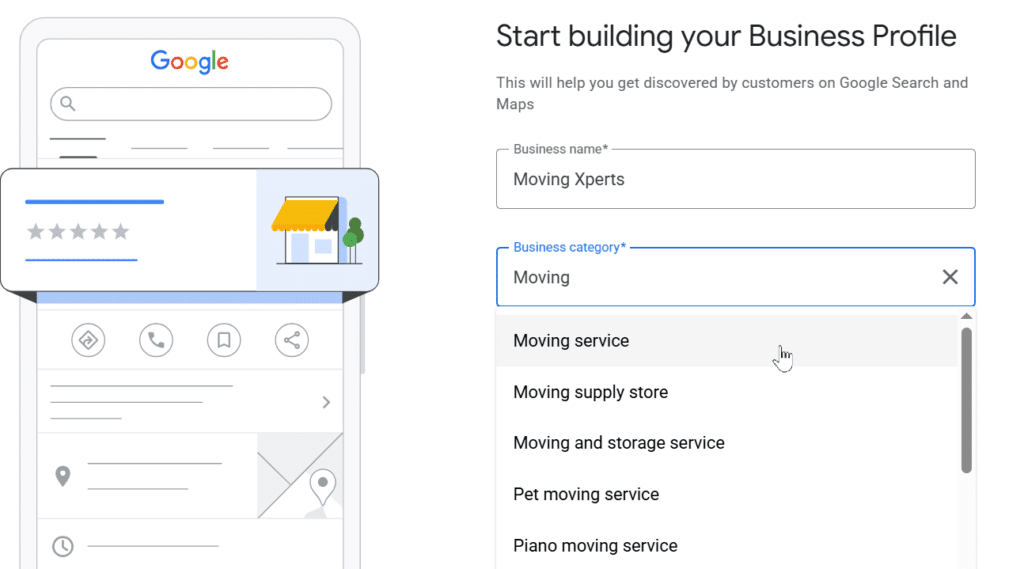
Keep in mind that you should only add those services and categories that you actually offer. For example, listing storage services that you do not have is a guidelines violation and generates calls you cannot convert. Check the categories used by the three listings currently ranking for your main city term and close any legitimate gaps.
Service Area Setup vs. Storefront Listings
Google has a proper mechanism to differentiate between businesses customers visit and service area businesses (SABs) that travel to the customer.
If local customers do not come to your office to buy anything, you are an SAB. Ideally, you should hide your address and define service areas instead (up to twenty, by city, zip code, or region).
A few rules that save headaches:
- Your address is still entered during verification even when hidden, and it must be a real staffed location, not a virtual office or mailbox.
- Define service areas where you actually dispatch trucks. Listing an entire state dilutes relevance without extending your reach.
- If you have a real warehouse or storefront where customers buy supplies, you can keep the address visible and also list service areas. That hybrid setup is usually stronger.
- Your pin location matters, because map visibility radiates outward from it. A central location often outperforms a cheaper industrial-park address.

Photos, Posts, Q&A, and Messaging
You should add real photos only to your Google Maps profile. These photos include branded trucks, uniformed crews, wrapped furniture, your warehouse, and your team.
Upload steadily rather than in one bulk dump. Clean trucks and professional crews close better than a logo and nothing else.
A few other key things to add are:
- Posts. Use them for peak-season availability, off-season offers, new service areas, and community involvement. Posts expire, so aim for two per month.
- Q&A. Anyone can ask or answer here, which means competitors and strangers shape your public information if you ignore it. Seed it yourself with the ten questions you field on every estimate call (packing materials, licensing and insurance, stair charges, cancellation policy) and answer from your business account. Check weekly.
- Messaging. Enable it only if someone answers within minutes during business hours. Slow replies hurt more than the feature helps.
Multiple Locations and Franchises
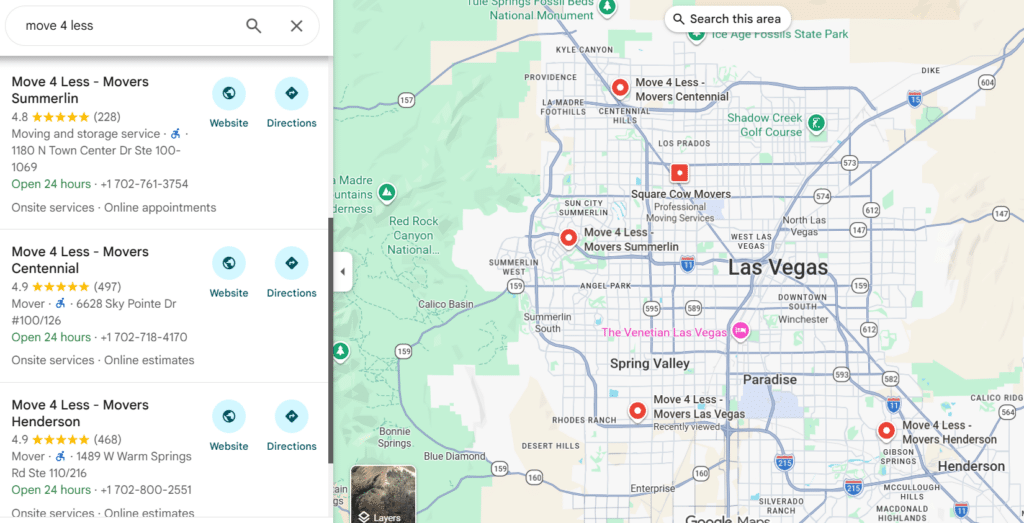
Each genuine location gets its own profile, its own verified address, its own local phone number, and its own dedicated landing page. Never point multiple profiles at your homepage.
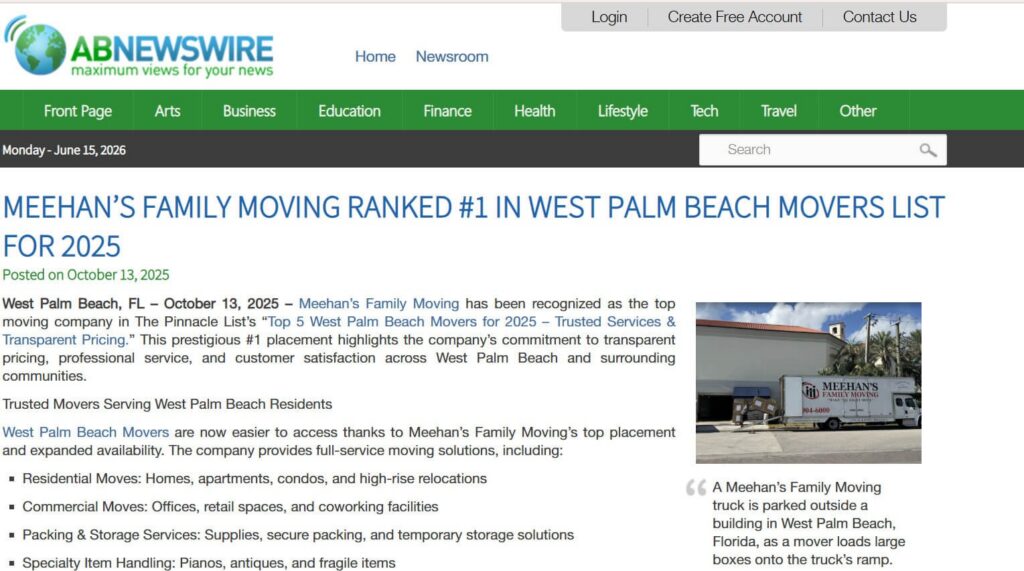
Keep service areas distinct between locations. Two profiles competing for the same city cannibalize each other, and Google may filter one out entirely. Here’s an example of a moving company with multiple listings for multiple locations:
On-Site Local SEO
Google cross-references your profile against your website, which makes on-site structure a direct input to map performance.
City and Service Area Landing Pages
You need a real page for each meaningful city you serve, not a footer link. The common mistake is templating these service and location pages and swapping the city name. Google recognizes near-duplicates and declines to rank most of them.

To build pages that hold up:
- Write genuinely different content for each. Reference local neighborhoods, building types, parking and permit realities, and HOA rules. A dense urban page discussing elevator reservations and street permits is naturally different from a suburban page about long driveways and storage.
- Include local proof: reviews from customers in that city, photos from local jobs, named neighborhoods you serve.
- Keep URLs consistent, such as /movers/[city]/, sitewide.
- Skip cities you cannot serve. Thin pages for towns you have never worked in are a quality and credibility problem.
- Interlink sensibly to relevant service pages and nearby city pages.
- Give every page a clear call to action. A quote form and a click-to-call number, both visible without scrolling, are the difference between a page that ranks and a page that books. Traffic you have earned and then failed to convert is the most expensive kind.
- Keep the pages fast on mobile. Visitors arriving from search engines on a phone with a truck already reserved will not wait out a slow render, and moving queries skew more mobile and more urgent than almost any other local category.
- Use internal linking to connect each page to relevant pages, including related service pages and nearby city pages.
- Audit broken links once or twice a year while you’re focusing on local SEO. They accumulate quietly as service areas and phone numbers change.
You don’t need to build all of the city pages in one go. For example, if you serve thirty cities, you can start by building eight optimized pages before adding more.
Local Keyword Targeting
Local moving searches follow predictable patterns. Keyword research here is less about chasing volume than about matching localized keywords to the pages that can actually satisfy them, such as:
- movers in [city]
- [city] moving company
- long distance movers in [city]
- apartment movers [city]
- office movers in [city]
- packing services [city]
- how much do movers cost in [city]
Here’s an example of local SEO keyword for a moving company based in Phoenix.

Google Keyword Planner is the free starting point for pulling monthly search volumes and surfacing local search terms you had not considered.
You should start by sorting relevant keywords by intent before you write anything.
- Transactional phrases, such as “local movers in [city],” belong on service and city pages where someone can request a quote.
- Informational ones like “movers cost in [city],” “how to pack a kitchen,” belong in blog content that feeds the same funnel from further upstream.
- Mixing the two on one page satisfies neither.
Ideally, you should map one primary combination per page. The city page targets “movers in [city],” while a dedicated page targets “long distance movers in [city].” Trying to rank one page for every service in a city leaves you mediocre at all of them and minimizes the chances of actually getting ranked.
When you are building these pages, follow SEO best practices. These mainly include using the term in your title tag, H1, first hundred words, one subheading, meta description, and image alt text. That is enough. Repeating the city twenty times reads badly and does nothing.
Location-Specific Schema Markup
Implement LocalBusiness (or MovingCompany) schema on your homepage and contact page with exact name, address, phone, hours, and geo coordinates. Add areaServed properties listing your cities and zip codes, Service schema on service pages, BreadcrumbList for hierarchy, and AggregateRating where you have genuine review data.
Every value must match your GBP and site footer exactly. Contradictory schema ifs worse than none.

Citations and NAP Consistency
A citation is any online mention of your name, address, and phone number (NAP). Consistent citations across trusted sources give Google confidence that your business is real and located where you claim.
Core Directories to Prioritize
Start with the general business directories and platforms: Google Business Profile, Bing Places, Apple Business Connect, Yelp, Facebook, Better Business Bureau, Angi, Thumbtack, and the major data aggregators.
Moreover, you should add industry local directories that carry real weight:
- your FMCSA registration with USDOT and MC numbers
- your state moving association directory, MyMovingReviews and Moving.com
- your local chamber of commerce.
Overall, fifty relevant, accurate local listings beat five hundred scraped ones.
Here’s an example of a well-optimized Google Business Profile:

Then add industry sources that carry real weight: your FMCSA registration with USDOT and MC numbers, your state moving association directory, MyMovingReviews and Moving.com, and your local chamber of commerce. Fifty relevant, accurate listings beat five hundred scraped ones.
How Inconsistent NAP Data Hurts You
Inconsistency is usually accidental. You changed warehouses in 2019, but three directories still show the old address. Your business is “Moving Xperts” in one place and “Moving Xperts Company LLC” in another.
Each mismatch weakens the association between your business and its location, and in bad cases creates duplicate entities that split your authority. Old addresses are especially damaging because they pull relevance toward a geography you no longer serve.
Pro tip: Audit annually and standardize one exact format matching your GBP. Local SEO tools like BrightLocal will surface your NAP mismatches and help you fix them.
Review Generation and Reputation
Reviews feed the prominence signal, and quantity, average rating, recency, and the wording of the reviews themselves all appear to contribute. Customer feedback is one of the few inputs that lifts local rankings and closes sales at the same time.
A review reading “great long distance move from [city]” reinforces relevance in a way on-page work cannot replicate because these are from actual people who’ve used your moving service. Reviews matter even more for conversion than they do for ranking.
A shopper comparing three Map Pack listings shortlists on rating and review count, then reads recent reviews to break the tie.
Ongoing review management, including asking consistently, replying quickly, and watching where your online reputation sits relative to the Map Pack incumbents, is the part that compounds.
Systems for Requesting Reviews Post-Move
Asking works, but only systematically. Build it into your job close-out:
- Ask in person when the customer signs off and is happiest. The crew lead doing this raises response rates more than any automation.
- Text within two hours, with a direct link to your Google review form (not your website). Text substantially outperforms email here.
- Send one email reminder at 48 hours if nothing has appeared.
- Stop after two touches.
- Track the ratio. Under 20 percent of jobs producing a review usually means the problem is the ask, not the customers.

Never offer discounts or drawing entries in exchange for reviews, and never route only happy customers to Google. Both violate policy and put your entire review base at risk. Spread requests evenly instead of batching fifty at once, which keeps velocity looking natural and recency healthy.
Responding to Negative Reviews
Every mover gets them. The response is read by far more prospects than the complaint.
Reply within 24 hours. Acknowledge the issue, state briefly what happened without arguing details, and move resolution offline:
“We are sorry the delivery window slipped. That is not our standard. Please call our operations manager at [number] so we can make this right.”
Avoid defensive walls of text and never disclose customer details. A measured reply to a two-star review often converts readers better than an unbroken row of five stars, because it shows how you behave when something goes wrong. Respond to positive reviews too, briefly and without a template.
Local Link Building Basics
You do not need aggressive link building, but a modest base of genuine local links separates you from competitors with none.
- Chamber of commerce membership in each local area where you have a real presence, linked to the matching city page.
- Local sponsorships: youth sports teams, school fundraisers, community 5Ks, festivals. Cheap, and genuinely local.
- Adjacent business partnerships: real estate agents, brokerages, property managers, apartment complexes, senior living communities, storage facilities, home stagers. Preferred-vendor arrangements with resource page links both directions.
- Charity work: free moves for families in need or donation hauling earns coverage from community outlets and nonprofit sites.
- Local press and neighborhood publications, especially around peak season.
Avoiding Common Local SEO Mistakes
Here are some of the common mistakes you should avoid while handling local SEO for businesses:
- Keyword stuffing your GBP company name. Changing “Smith Moving” to “Smith Moving | Best Movers in [city]” is a direct violation of Google’s guidelines. It sometimes works briefly, but it is also the easiest thing for a competitor to report.
- Creating fake locations. Virtual offices, mailbox stores, and a relative’s house are the most damaging shortcut in local SEO.
- Duplicate and spam listings. Multiple profiles for one location split your signals and risk suspension. Audit and resolve them properly.
- Neglecting the profile after setup. Outdated business details, such as hours, an old phone number, no photos in three years, unanswered questions.
- Ignoring compliance details. Displaying USDOT and MC numbers, state licensing, and insurance information is often required and builds the trust that converts searchers into calls.
Tracking and Measuring Results of Local SEO for Moving Companies
Rankings are a proxy. Booked jobs are the metric.
Map Pack rank tracking. Standard rank trackers report one position per keyword, which is misleading locally because rankings shift with the searcher’s exact location. Use geo-grid tracking that samples your position across points throughout your service area. That shows how far visibility extends from your pin and where it drops off.
GBP performance data. Track calls, direction requests, and website clicks, and watch the split between direct searches (people looking for you by name) and discovery searches. Growth in discovery searches means your local SEO is working.
Call tracking. Most moving leads arrive by phone. Use dynamic number insertion on your site and a separate tracking number on GBP, but list your real number as an additional number there to preserve NAP consistency. Score phone calls for lead quality, not just volume.
Form conversions. Configure conversion tracking in GA4 for every quote form and tag submissions with the landing page, so you can see which city pages produce estimate requests.
Closing the loop. Capture lead source in your CRM and report booked jobs and revenue by source, not leads by source. A channel producing 40 leads and 4 booked moves is worse than one producing 15 leads and 9. Ask “how did you hear about us” on every estimate and log the answer.
Review monthly, judge quarterly. Local search improvements typically take 60 to 90 days to appear in map rankings.
Quick-Reference Checklist
The following image summarizes the above guide and provides a quick reference checklist you can use to ensure your moving company’s website and business profiles are optimized as per local SEO best practices.

Getting Expert Help
Everything above is executable by an owner or in-house coordinator willing to be methodical when it comes to getting the best results from local SEO. Even though the work itself is not technically difficult, it is quite comprehensive and requires ongoing effort.
The two costs of running a local SEO strategy alone are time and mistakes. A suspension from an avoidable name violation, templated city pages Google refuses to index, or a citation cleanup done in the wrong order can set you back months.
If you would rather compress the timeline and skip the trial and error, specialist agencies such as Mover Search Marketing provide moving company SEO services exclusively to the moving industry, so they already know how the Map Pack behaves in this industry, which directories move the needle, and where the compliance landmines are buried.
Either way, the principle of local SEO holds. A moving company competes as a local business first and a website second. The companies that dominate their service area are not the ones with the biggest websites. They are the ones nearby customers find in the map results, in the right cities, with the reviews to back it up.
Frequently Asked Questions
How Long Does Local SEO Take to Work for a Moving Company?
You can expect early movement in 60 to 90 days and meaningful results in four to six months. Profile optimization and review velocity show up fastest, while city pages and citation cleanup compound more slowly.
Do I Need a Physical Office to Rank in the Map Pack?
You need a real, verified address, but not necessarily a customer-facing one. Service area businesses usually hide the address and define service areas instead. What you cannot use is a virtual office, mailbox rental, or an address you do not actually operate from.
How Many Google Reviews Do I Need to Compete?
There is no fixed number. Check the review counts of the three listings currently in the Map Pack for your main city term and treat that as the target. In most metros that means 100 or more reviews at 4.5 stars or better, plus a steady stream of new ones.
Can I Rank in Cities Where I Do Not Have a Location?
Organically, yes, with a genuinely useful city page. In the Map Pack it is much harder, because proximity heavily influences local results.
Is Local SEO Better Than Paid Ads for Movers?
They do different jobs. Paid ads (including Local Services Ads) produce leads immediately and stop when you stop paying. Local SEO takes months but compounds without per-click cost. Most of the established moving companies run both local SEO and paid ad campaigns.
What Is the Single Most Impactful Thing I Can Start Today?
You should have your moving crew lead ask for a review in person at the end of every job. It is free, it strengthens your most important ranking and conversion signal, and it starts working within weeks.
Author Bio:
Bryan Bloom is a digital marketing expert who helps moving companies grow through SEO, PPC advertising, and high-converting website design. As the former owner of Priority Moving, Inc. in San Diego, he built the company’s online visibility from the ground up, earning top rankings for competitive moving-related searches and driving significant growth before the business was sold. Bryan later founded Mover Search Marketing, where he helps moving companies across the United States improve search rankings, generate qualified leads, and strengthen their online presence. A recognized voice in the moving industry, he has written extensively about SEO for movers and regularly speaks at industry events nationwide.
About Mover Search Marketing
Mover Search Marketing helps moving companies generate more leads through SEO, Google Business Profile optimization, website design, paid advertising, and AI search optimization.
Unlike general marketing agencies, we focus exclusively on the moving industry. We understand what movers need because we’ve spent years working with moving companies and helping them grow.
Our goal is simple: increase your visibility, generate more qualified leads, and help you book more moves.
Find A Moving Company Supplier
About Moversville
Moversville Marketing Services for Movers – Boost repeat business, increase referrals, and stay top-of-mind year-round—all without writing a single email. Moversville gives moving companies a fully managed email marketing system, complete with custom content, automated campaigns, and consistent monthly outreach to your past clients, referral partners, and leads. It’s hands-off, high-impact marketing built specifically for movers.