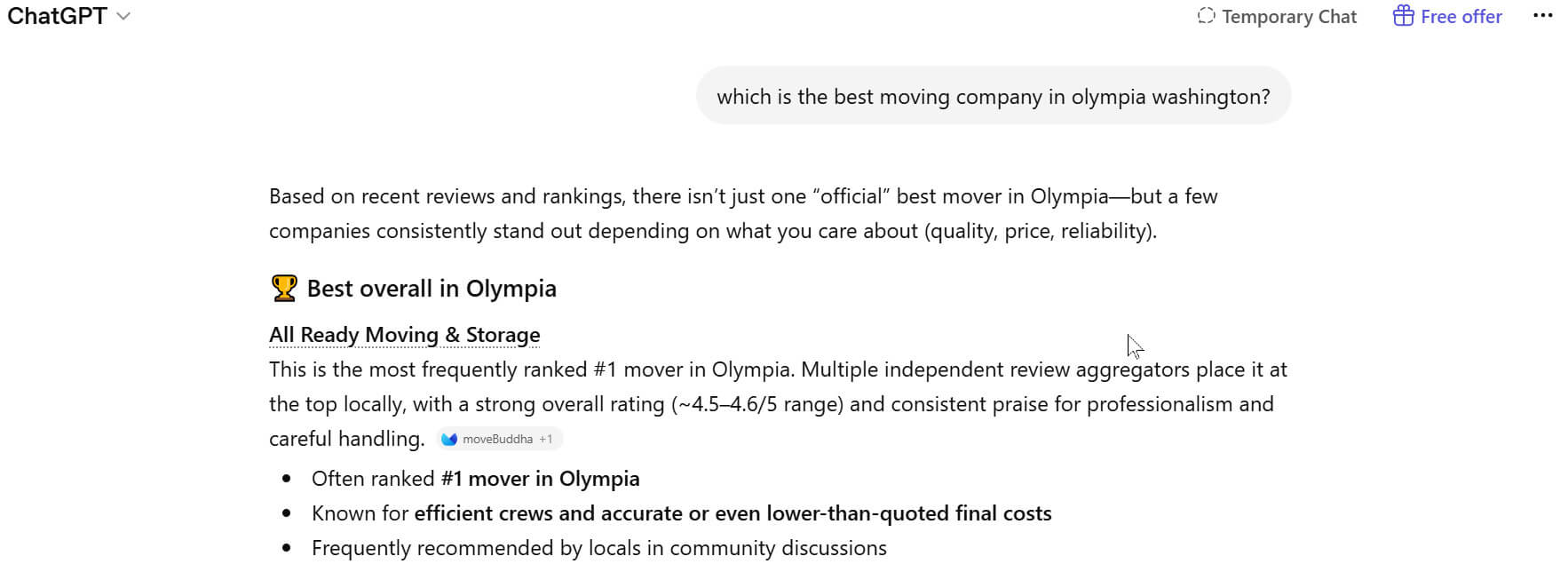
A growing share of your future customers will never see a list of ten blue links. They will open ChatGPT, Gemini, or Google’s AI Mode and ask something like “who are the best movers in Washington DC?”
The answer comes back as a short, confident recommendation naming two or three companies. Most people stop reading there. In fact, statistics indicate that 45% of consumers now use ChatGPT or another generative AI tool to find local businesses, up from 6% a year earlier.
If your moving company is one of the names in those answers, you win jobs you never had to compete for. If it is not, you are invisible to that customer before your website gets a single visit. Answer engine optimization, abbreviated as AEO, is all about becoming one of those names. This guide explains how AI search actually works, why traditional SEO alone no longer covers you, and what AEO for moving companies looks like in practice.
What Is Answer Engine Optimization?
Answer engine optimization is a set of tools and techniques used to make your business easy for AI systems to understand, verify, and recommend. The goal of Traditional SEO is to rank your pages in a list of search results, while AEO gets your company cited or named inside the direct answer itself.

You will also hear the terms generative engine optimization (GEO) and AI search optimization. They describe the same discipline with different labels: earning visibility across AI platforms rather than only in ranked lists.
Here is the part that trips people up in the AEO vs. SEO debate. These are not competing strategies.
Google’s own guidance for generative AI features says the SEO fundamentals that have always mattered still apply. There are no separate requirements for appearing in AI Overviews or AI Mode. AEO builds on top of a solid SEO foundation.
It adds emphasis on:
- Direct answers
- Machine-readable structure
- Third-party corroboration
A mover with weak SEO cannot shortcut to AI visibility. A mover with strong SEO can extend it, though not automatically.
Interestingly, only about 14% of the URLs cited in Google’s AI Mode also rank in the organic top 10. Rankings help. They do not transfer to AI citations on their own.

Why AI Search Matters for Moving Companies
The scale of AEO for moving companies or any other business is no longer speculative. Google reports that AI Overviews now reach more than 2.5 billion monthly users, and AI Mode has passed one billion monthly active users.
ChatGPT, Gemini, Perplexity, and Claude handle millions of local recommendation questions on top of that.
The click math has changed too. Ahrefs measured a 58% drop in the top-ranking page’s clickthrough rate when an AI Overview appears. In other words, ranking at the first position no longer guarantees traffic. The answer box absorbs it, and the cost deepened as the feature matured.
Impact on Moving Industry
Moving is a high-intent, deadline-driven purchase. When an AI assistant hands someone a three-company shortlist, that shortlist often becomes the entire consideration set.
The customer just has to deal with those three, compares quotes, and books. Companies outside the answer never got evaluated. In traditional search, you could win with position four. In answer engines, you are either named or you are absent.
How AI Assistants Choose Which Movers to Recommend
AI assistants build recommendations in one of two ways.
Some answers come from what the model learned during training. Others come from live AI retrieval, which includes the searches that the assistant runs in the background, sometimes dozens of them for a single question, before it synthesizes what it found. Google calls this query fan-out.
Either way, the assistant leans on sources it trusts, and it looks for agreement between them. That is the core principle of AEO: corroboration. An AI system is far more likely to recommend a mover whose story checks out across multiple independent places.
In practice, the sources that carry the most weight for a local service recommendation are:
1. Third-party roundups. Presence on expert-curated “best of” lists ranks as the strongest single local AI visibility factor. In other words, “Best Movers in [City]” articles are source material.

2. Review platforms. Volume, ratings, recency, and the content of the reviews themselves. Assistants quote review themes back to users.

3. Established directories and citations. Consistent business data across Google, Yelp, the BBB, and industry directories confirms you are real and active.
4. Your own website. Clear, factual, specific statements about what you do, where you do it, and what it costs. The site does not make the case alone, but it anchors it.
5. Authority and credibility still matter the way they always have. A company with real links, real mentions, and a consistent footprint beats a company with a pretty website and nothing behind it.
Related: Why ChatGPT Recommends Some Moving Companies, and Ignores Others
Create Content That Answers Real Questions
Answer engines do exactly what the name says. They answer questions. Structuring content so that each section opens with a direct answer is what gets it pulled into those responses.
The format matters as much as the topic.
Use question-shaped headings that match how customers actually ask: “How much does it cost to move a three-bedroom house?” instead of “Pricing Information.”
Question-form searches produced an AI summary 60% of the time, against 8% for one- or two-word searches. Moreover, natural phrasing beats stacked and overstuffed keywords. Then answer in the first sentence or two, with the number, the range, or the condition up front, and keep that opening tight, as the median AI summary in the same study ran 67 words.
Context and detail come after. Writers call this the inverted pyramid, and it is the same structure that won featured snippets a decade ago.

Machines reward it because they can lift a complete answer without guessing. Keep the paragraphs underneath short too, one to three sentences each, so a system can lift one without dragging in three unrelated points.
Every mover already knows the customer questions. They come in on the phone every day, such as:
- How far in advance should I book?
- Do you move pianos?
- How much should I tip the crew?
- Can you pack everything for us?
- Are you licensed and insured?
- What will you not put on the truck?
- Is a deposit required?
Each of those deserves a clear written answer on your site.
Build a Comprehensive FAQ Page
A strong FAQ page is one of the highest-leverage AEO assets a mover can build, and most FAQ pages fail at it. The difference comes down to how the answers are written.
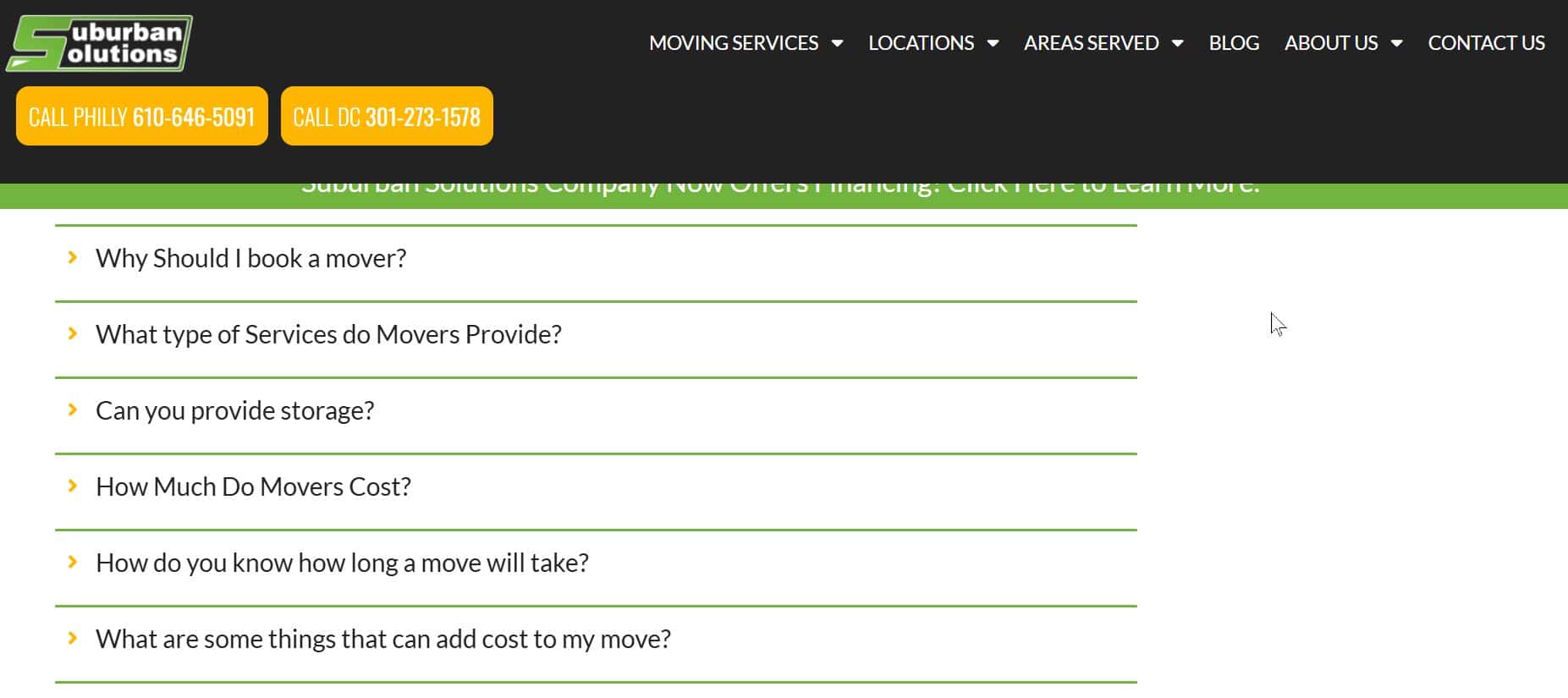
Here are a few things to keep in mind while writing FAQs for AEO:
- Keep each answer between roughly 60 and 100 words. Long enough to be complete, short enough to be quotable.
- Concise answers are what survive the trip into a generated response.
- Make every answer fully self-contained, so it makes sense with zero surrounding context.
- Write factually, not promotionally. “Book two to four weeks ahead for a local move, and six to eight weeks for peak summer dates” gets cited. “Contact our award-winning team today!” might get skipped.
- Put at least one specific fact, condition, or local detail in every answer, because specifics are what separate a citable source from filler.
Structure Service Pages So Machines Can Parse Them
The same logic extends to service pages. One page per service, with a heading that states plainly what the service is and where you offer it.
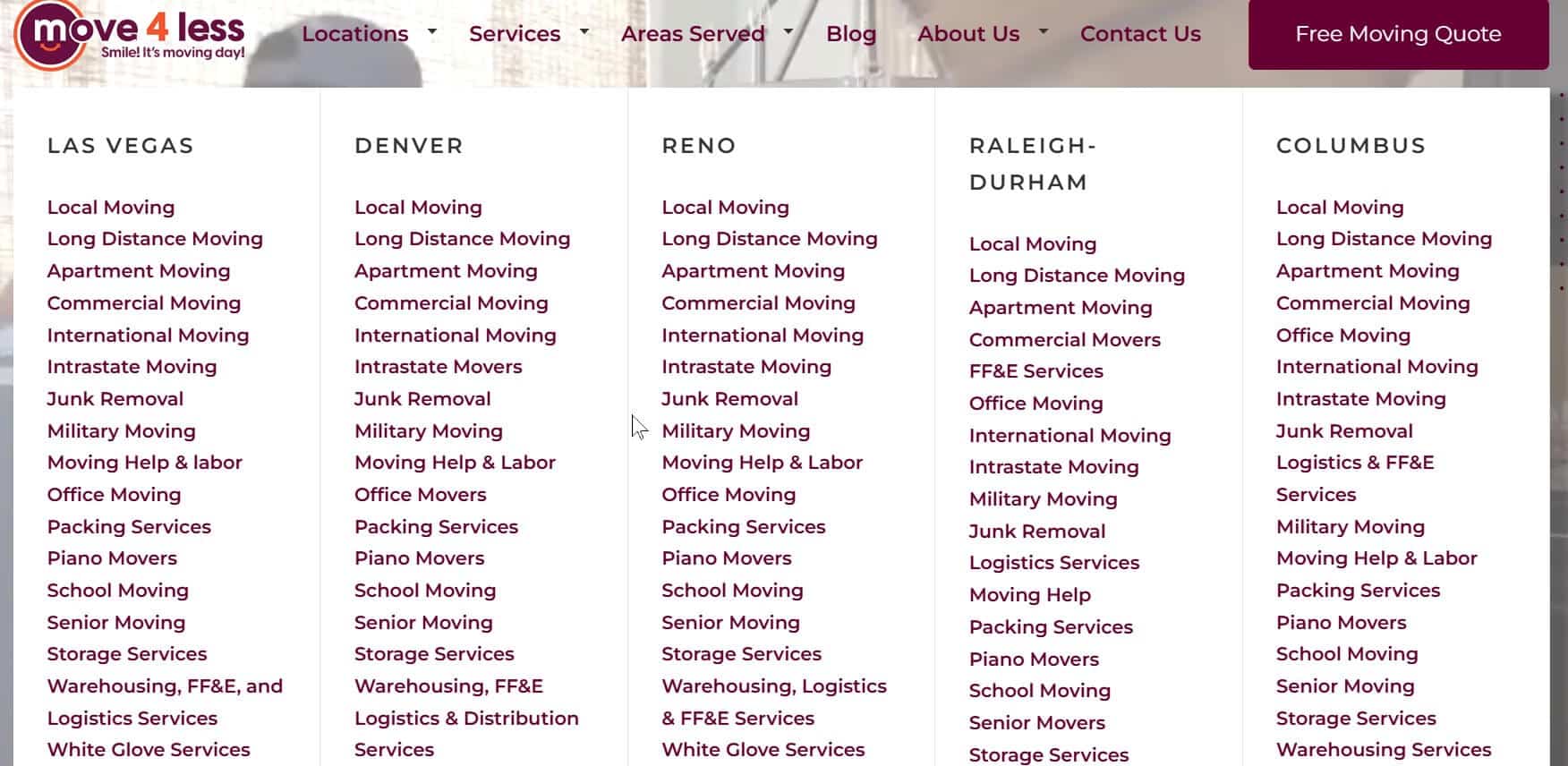
A page for local moves, a page for long distance, a page for commercial work and office relocation, and so on.
Sections with descriptive headings:
- What is included
- How pricing works
- What service areas you cover.
- Name your cities, neighborhoods, and every location you actually serve in the text instead of gesturing at “the greater metro area.”
Clever headings hurt you here. “White Glove, Zero Stress” tells a machine nothing. “Full-Service Packing in Fort Worth” tells it everything.
If a page is easy for a stressed customer to scan, an AI system can easily understand it too. The two audiences want the same structure.
Use Schema Markup to Improve Machine Readability
Schema markup is code, usually JSON-LD, that labels your business information in a format machines read directly. Your visitors never see it. Search engines and the AI systems built on them do.
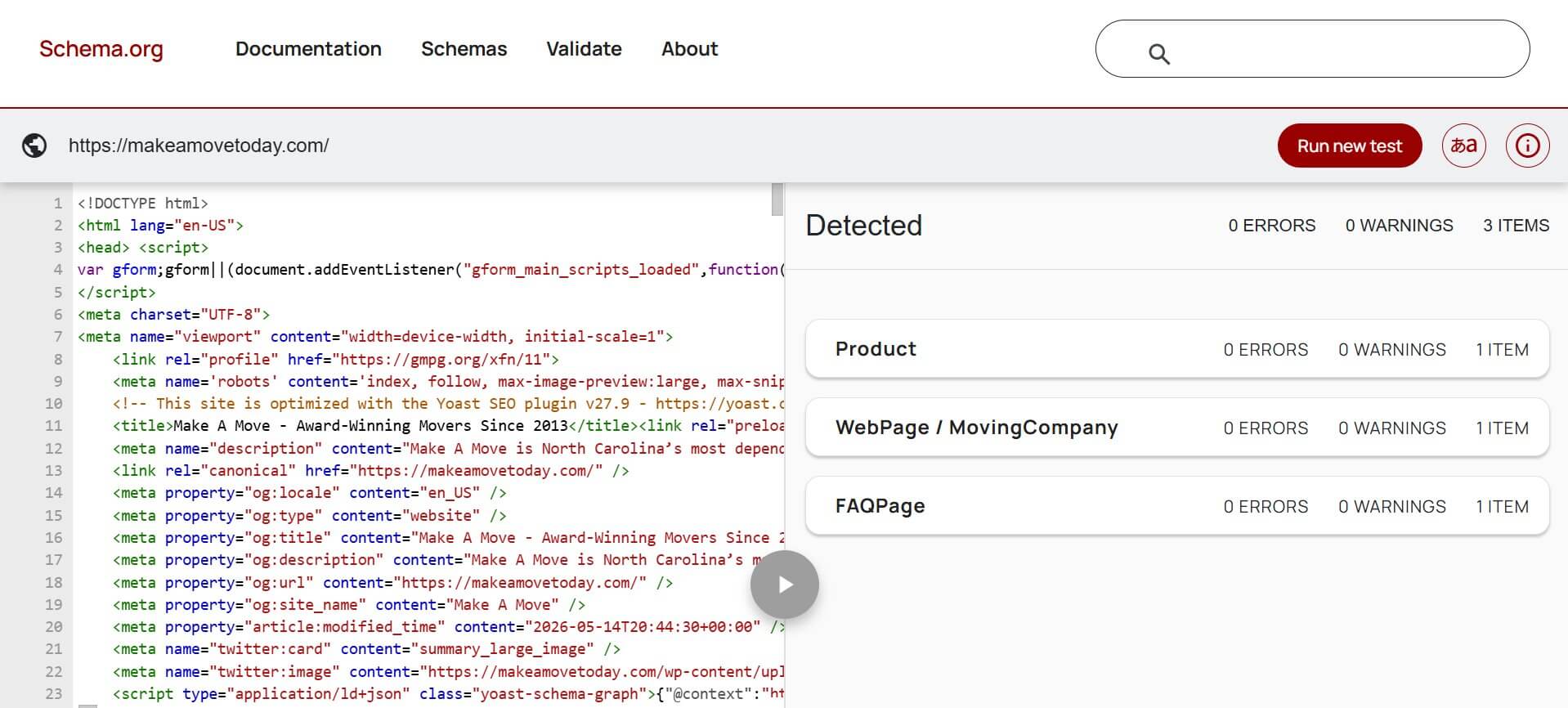
Moving companies should start with a LocalBusiness / MovingCompany type declaration plus your exact name, address, phone, geo coordinates, and hours.
Add a service catalog listing each service you offer, and an areaServed property naming your cities and zip codes. If you maintain a real FAQ page, FAQPage markup labels each question and answer pair.
Keep in mind that schema does not guarantee a ranking or a recommendation. What it does is remove ambiguity. It tells every machine reading your site which business you are, which of the twelve suburbs you serve, and which services are yours.
Why E-E-A-T Matters Even More in AI Search
Google evaluates content through E-E-A-T:
- Experience
- Expertise
- Authoritativeness
- Trustworthiness

The framework predates AI search, but answer engines raised the stakes. A system generating one confident answer has to bet on sources it considers reliable, and it is pickier about that bet than a results page ever was.
Examples of EEAT for Movers
Experience means content only an actual moving company could write: real job photos, crew names, what a fourth-floor walkup actually involves.
Expertise means specifics, like weight-based versus hourly pricing and when each applies. Authoritativeness means other credible sites reference you.
Authoritativeness and Trustworthiness mean your USDOT number, licensing, insurance details, and a physical address sit in plain view.

You should also consider including a short trust block to answer who wrote the page, what they actually do, and which sources the claims come from. Such information does more work here than another paragraph of adjectives.
Build Brand Mentions and Backlinks That Influence AI
Backlinks still matter, but AEO widens the target. Unlinked brand mentions count too, because AI models learn associations from everything they read.
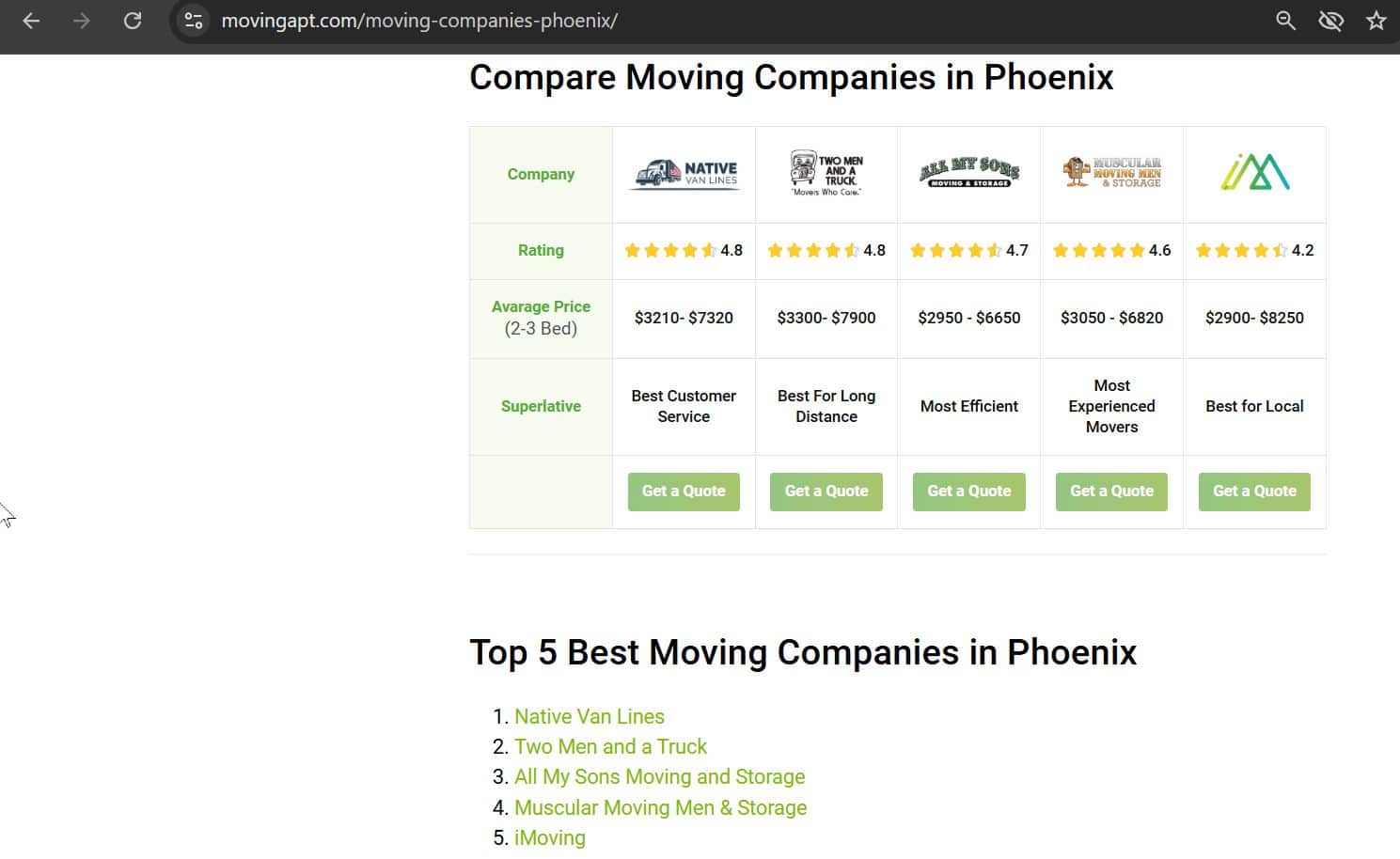
When your company name keeps appearing next to “reliable,” “Phoenix,” and “moving” across dozens of independent pages, that association becomes part of how machines understand you. Here’s one example:
The priorities for a mover:
- Placements in best-movers roundups, since those lists feed both link authority and AI recommendations directly.
- Local press coverage, which usually follows community involvement rather than press releases.
- Partnerships with real estate agents, property managers, and storage facilities that list you as a trusted vendor. Those relationships produce referral leads and AI-visible mentions at the same time. Industry association memberships with member directories.
Ten relevant mentions in your market beat a hundred random links from nowhere. The spam shortcuts that limped along in traditional SEO carry even less weight with systems built to cross-check sources.
How Local SEO Supports AEO Success
Everything covered in local SEO feeds AI answers, because assistants pull heavily from local data sources when someone asks a near-me question.
Your Google Business Profile supplies structured facts that Gemini and AI Overviews consume directly: categories, services, hours, photos, and review data.
Reviews carry double weight, since assistants both count them and quote their themes. BrightLocal’s consumer survey found 97% of people read reviews for local businesses, and 41% read them every time they compare options.
And citation consistency does for AI what it always did for the map pack. Identical name, address, and phone details across the web are the corroboration an answer engine checks before it stakes a recommendation on you.
If you have already done serious local SEO work, you have a real head start on AEO. But the overlap is not total.Winning the map pack does not automatically make you visible in an AI answer. Closing that gap is the work.
Measuring AI Visibility and Monitoring Mentions
You cannot pull one clean ranking report for AI visibility yet, but you can track it with a repeatable routine and a handful of consistent metrics.
- Test prompts by hand. Ask ChatGPT, Gemini, Perplexity, and Claude the questions your customers ask: best movers in your city, who to hire for a long-distance move out of your state.
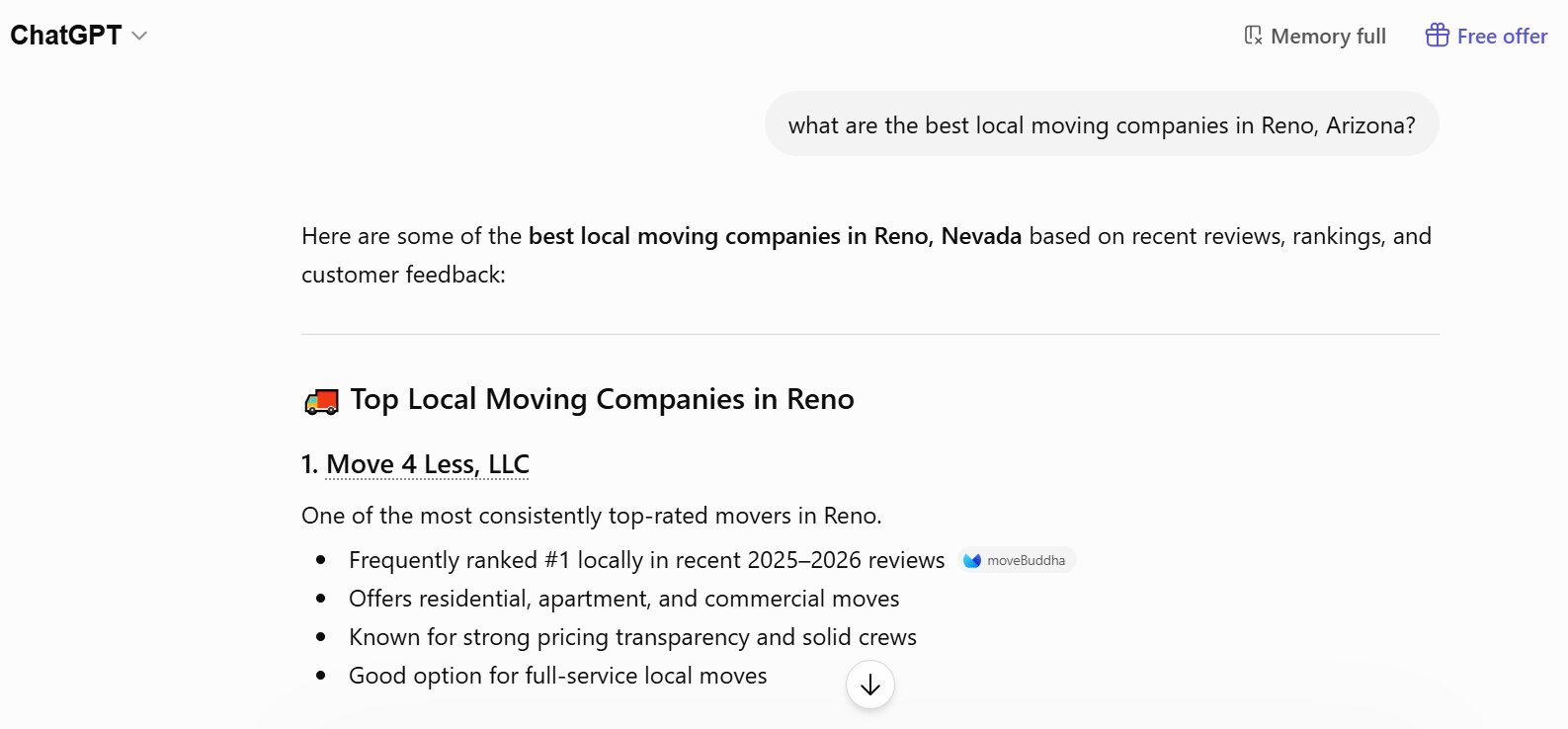
- Record which competitors get named and which sources get cited. Then repeat the same prompts monthly, and run each one more than once, because AI answers vary between sessions. A single run tells you less than a pattern does.
- Watch your analytics for referral traffic from chatgpt.com, perplexity.ai, and gemini.google.com. Those sessions are people who arrived from an AI answer.
- Google has also begun rolling out Search Console reporting for generative AI features, including impressions data for pages appearing in AI responses. Turn it on and watch the trend, not the daily noise.
Common AEO Mistakes Moving Companies Make
The same errors show up repeatedly. Here are the most important ones:
- Treating AEO as a hack instead of an extension of SEO, and chasing tricks while the foundation stays broken.
- Publishing a wall of thin, AI-generated FAQ answers that state nothing specific, which reads as filler to the systems it was meant to impress.
- Pouring every hour of focus into the company website while ignoring the third-party presence that answer engines actually cite.
- Letting reviews go quiet for a year, which stales the exact signal assistants weigh most for local trust. 74% of consumers look specifically for reviews written in the last three months.
- Writing promotional copy where factual copy was needed.
- Blocking AI crawlers in robots.txt without understanding the trade, which for a local service business usually means cutting off access to the recommendation channel entirely.
None of these mistakes is fatal on its own. Together they explain most of the movers who are invisible in AI answers today.
Frequently Asked Questions About AEO for Moving Companies
What Is AEO for Moving Companies?
AEO for moving companies is the practice of structuring your website, reviews, and third-party presence so AI assistants name your business when someone asks for a mover. Traditional SEO aims to rank a page in a list. AEO aims to get your company named inside the generated answer.
Does AEO Replace Traditional SEO?
No. AEO is an extension of SEO instead of its replacement. Google’s guidance for generative AI features states there are no separate requirements for appearing in AI Overviews or AI Mode, so the same fundamentals apply. What AEO adds is emphasis on direct answers, machine-readable structure, and third-party corroboration.
Can a Moving Company Rank on Google and Still Be Invisible in AI Answers?
Yes, and it is common. SOCi’s 2026 Local Visibility Index found ChatGPT recommended only 1.2% of local business locations, compared with 35.9% visibility in Google’s local 3-pack for the same brands. AI assistants weigh third-party roundups, review recency, and citation consistency differently than Google’s local algorithm does.
How Long Should an AEO Answer Be?
Lead with a complete answer in the first sentence or two, then add context. Write about 60-100 words in for FAQ answers. Keep paragraphs to one to three sentences so a system can extract one point without dragging in unrelated ones.
Does My Website Need to Be Fast for AI Visibility?
Yes. AI systems that fetch pages live are subject to crawl timeouts, and a page that loads slowly or blocks crawlers may never be read at all. Confirm your robots.txt does not block AI user agents.
How Often Should a Moving Company Refresh Its Content?
Refresh when the substance changes, not on a calendar. Update pricing ranges, service areas, and crew or fleet details as they shift, and treat reviews as the highest-priority freshness signal.
Preparing for the Future of AI-Driven Search
Answer engine optimization for moving companies comes down to being legible and being corroborated.
Structure your site so machines can parse it, answer real questions in quotable form, and mark up your business data. Then build the reviews and third-party mentions that let an AI system check your story from multiple angles. Start with your FAQ page and your Google Business Profile this month, then work outward.
The movers showing up in AI answers today are the ones whose fundamentals were already strong when the interfaces changed.
Many owners bring in professional help at this point. Specialist agencies like Mover Search Marketing help moving companies optimize for both traditional search engines and AI-powered search experiences, since the two now succeed or fail together.
Author Bio:
Bryan Bloom is a digital marketing expert who helps moving companies grow through SEO, PPC advertising, and high-converting website design. As the former owner of Priority Moving, Inc. in San Diego, he built the company’s online visibility from the ground up, earning top rankings for competitive moving-related searches and driving significant growth before the business was sold. Bryan later founded Mover Search Marketing, where he helps moving companies across the United States improve search rankings, generate qualified leads, and strengthen their online presence. A recognized voice in the moving industry, he has written extensively about SEO for movers and regularly speaks at industry events nationwide.
About Mover Search Marketing
Mover Search Marketing helps moving companies generate more leads through SEO, Google Business Profile optimization, website design, paid advertising, and AI search optimization.
Unlike general marketing agencies, we focus exclusively on the moving industry. We understand what movers need because we’ve spent years working with moving companies and helping them grow.
Our goal is simple: increase your visibility, generate more qualified leads, and help you book more moves.
Find A Moving Company Supplier
About Moversville
Moversville Marketing Services for Movers – Boost repeat business, increase referrals, and stay top-of-mind year-round—all without writing a single email. Moversville gives moving companies a fully managed email marketing system, complete with custom content, automated campaigns, and consistent monthly outreach to your past clients, referral partners, and leads. It’s hands-off, high-impact marketing built specifically for movers.